
In This Article, You’ll Learn: how fume hoods protect laboratory personnel from hazardous airborne contaminants, which performance factors have the greatest impact on safety and regulatory compliance, what to evaluate before selecting a fume hood, and how to choose the right solution for your laboratory.
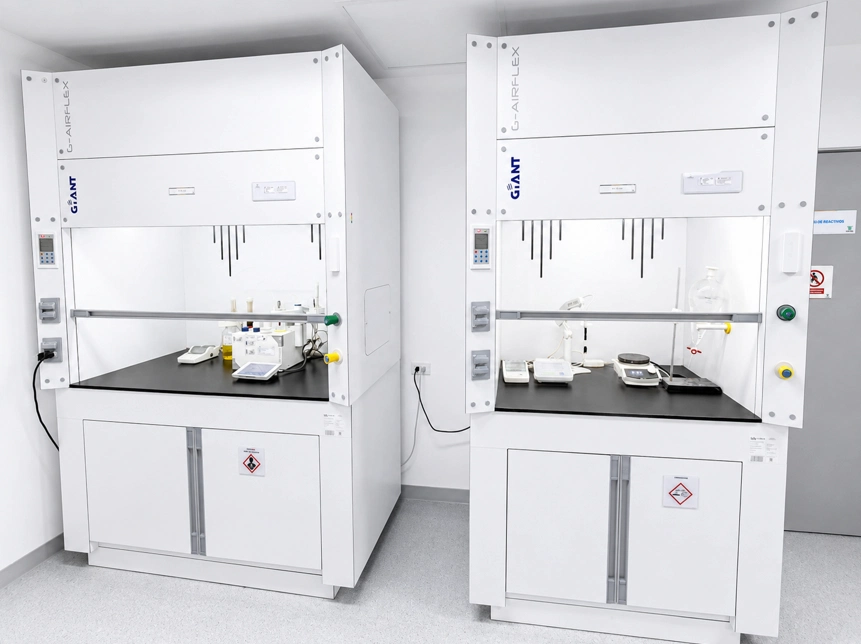
Installing a laboratory fume hood is only the first step toward creating a safe working environment, many laboratories assume that once a fume hood is operational, it will continue providing the same level of protection indefinitely. In reality, improper design, poor installation, inadequate maintenance, or non-compliance with industry standards can significantly reduce containment performance, increasing the risk of chemical exposure, contamination, and failed inspections.
This is why fume hoods performance and compliance must be evaluated continuously. Understanding how airflow, testing standards, user practices, and preventive maintenance work together allows laboratories to maintain safe operations while meeting regulatory and industry requirements.
A fume hood is an engineered ventilation system designed to capture, contain, and safely exhaust hazardous vapors, gases, aerosols, and chemical fumes generated during laboratory procedures, its effectiveness depends on maintaining stable airflow patterns that prevent contaminants from escaping into the laboratory. Although modern fume hoods are highly efficient, their performance can deteriorate due to improper airflow, poor user practices, inadequate maintenance, or changes in laboratory ventilation. Understanding the factors that influence fume hood performance allows laboratories to reduce exposure risks while maintaining consistent operational safety.
• Airflow and Face Velocity:
Airflow is the foundation of every fume hood, for contaminants to remain contained, the hood must maintain an appropriate face velocity across the sash opening, airflow that is too low allows hazardous vapors to escape, while excessive airflow can create turbulence that also reduces containment efficiency, modern laboratories continuously monitor airflow to ensure the hood operates within its specified performance range. Maintaining stable airflow is one of the most important requirements for long-term performance.
• Sash Position and User Operation:
Even a properly designed fume hood can lose effectiveness if operators use it incorrectly, the sash is not only a physical barrier—it also regulates airflow entering the hood. Operating with the sash fully open reduces containment performance, while rapid movements or improper positioning can disturb airflow patterns. Training laboratory personnel to work with the recommended sash height significantly improves operator protection and overall containment.
• Laboratory Ventilation and Environmental Conditions:
A fume hood does not operate independently from the building ventilation system, HVAC performance, room pressurization, supply air distribution, nearby doors, windows, and pedestrian traffic all influence airflow stability, poor laboratory ventilation can introduce cross drafts that disrupt containment even when the hood itself is functioning correctly. Coordinating laboratory HVAC design with fume hood installation ensures more reliable performance under real operating conditions.
• Preventive Maintenance and Inspection:
Like any engineered safety system, a fume hood requires regular maintenance. Fans, dampers, sensors, airflow monitors, belts, filters (where applicable), and exhaust systems should be inspected periodically to maintain optimal performance, routine preventive maintenance reduces unexpected failures while ensuring that airflow remains within acceptable operating limits. Laboratories that follow structured maintenance programs experience fewer performance issues and longer equipment life.
Maintaining fume hood compliance requires both proper equipment selection and ongoing performance verification.
• Verify Performance Testing:
Every laboratory should confirm that each fume hood has been tested according to recognized performance standards, tests typically include face velocity measurements, airflow visualization, and containment evaluations. Regular testing helps identify performance degradation before it becomes a safety hazard.
• Follow Applicable Standards:
Several recognized standards influence fume hood performance and compliance, among the most important are:
• SEFA 1 for construction and performance.
• ASHRAE 110 for containment performance testing.
• ANSI/AIHA Z9.5 for laboratory ventilation systems.
• Applicable OSHA requirements for workplace safety.
Following these standards helps laboratories establish consistent safety practices and simplify regulatory compliance.
• Train Laboratory Personnel:
Operator behavior has a direct impact on containment performance, personnel should understand proper sash operation, equipment placement, airflow limitations, and safe working distances inside the hood. Well-trained users significantly reduce the likelihood of containment failures.
• Establish Preventive Maintenance Programs:
Performance verification should not be limited to annual inspections, routine maintenance schedules ensure that airflow systems, mechanical components, alarms, and monitoring devices continue operating correctly throughout the equipment’s lifecycle. Preventive maintenance helps laboratories maintain both safety and compliance.
Before selecting a fume hood, verify:
• Compliance with ASHRAE 110 testing.
• SEFA 1 certification or compliance.
• Airflow monitoring capabilities.
• Face velocity specifications.
• Sash design and safety features.
• Exhaust system compatibility.
• Energy efficiency options.
• Maintenance accessibility.
• Manufacturer testing documentation.
• Compatibility with laboratory HVAC systems.
Evaluating these factors helps laboratories select fume hoods that provides reliable containment while meeting long-term operational and regulatory requirements.
| Approach | Standard Fume Hood | Norlab Fume Hood |
|---|---|---|
|
Airflow control |
Fixed |
Optimized variable air volume (VAV) |
|
Energy efficiency |
Moderate |
High |
|
Containment performance |
Standard |
Enhanced |
|
Airflow monitoring |
Basic |
Continuous monitoring |
|
Long-term operating cost |
Higher energy consumption |
Lower energy consumption |
Both systems provide effective containment when properly maintained, high-performance fume hood systems typically improve energy efficiency, provide better airflow control, and simplify long-term compliance, particularly in laboratories with demanding ventilation requirements.
Many laboratories unintentionally reduce fume hood performance through avoidable operational practices.
• Assuming Installation Guarantees Performance:
A newly installed fume hood still requires testing, verification, and periodic inspections to maintain proper containment.
• Ignoring Airflow Testing:
Without regular airflow measurements, laboratories may not detect declining containment performance until safety is compromised.
• Operating With the Sash Fully Open:
Incorrect sash positioning significantly reduces containment efficiency and increases operator exposure.
• Neglecting Preventive Maintenance:
Failing to inspect fans, sensors, exhaust systems, or airflow monitors eventually reduces performance and increases downtime.
• Overloading the Work Area:
Excessive equipment inside the hood disrupts airflow patterns and reduces contaminant capture efficiency. Maintaining an organized workspace allows the fume hood to perform as designed.
A fume hood is one of the most important engineering controls in any laboratory handling hazardous chemicals, maintaining optimal performance requires more than proper installation. Continuous airflow verification, preventive maintenance, operator training, and compliance with recognized standards such as ASHRAE 110, SEFA 1, and ANSI/AIHA Z9.5 help ensure reliable containment throughout the equipment’s service life. Rather than viewing a fume hood as a static piece of laboratory equipment, laboratories should manage it as a critical safety system that protects personnel, supports regulatory compliance, and contributes to the overall performance of the laboratory.
Not all fume hood models are equally suited for every process, and selecting the correct Airflex model for your application is one of the most important decisions in the specification process. The A-Airflex and F-Airflex fume hoods are designed for routine chemical operations such as light acid digestions, vapor and gas extraction, and chemical transfers including pipetting. These models are ideal for applications involving low to moderate concentrations of chemical fumes and vapors.
The G-Airflex and P-Airflex fume hoods are designed for more demanding chemical processes, including prolonged acid digestions and complex chemical reactions that generate higher concentrations of corrosive fumes. Their construction and airflow design make them better suited for handling aggressive acidic environments and continuous chemical processing. The right model for your specific application is determined during the design consultation based on the chemicals involved, the work procedures, and the laboratory’s ventilation requirements.
No, fume hoods and laminar flow cabinets serve fundamentally opposite purposes and cannot substitute for each other. Fume hoods are designed to protect the operator: they capture hazardous vapors, fumes, and gases generated inside the hood and exhaust them away from the user.
The airflow moves from the room toward the operator and then into the hood, creating a barrier between the work and the person. Laminar flow cabinets are designed to protect the product or sample from contamination: HEPA-filtered air flows either horizontally toward the operator or vertically downward over the work surface, creating a clean particle-free environment inside the cabinet.
Using a laminar flow cabinet instead of a fume hood when working with hazardous chemicals exposes the operator directly to vapors being pushed outward by the clean airflow — a serious safety hazard. If your process requires both product protection and operator protection simultaneously, that requires a biological safety cabinet (BSC Class II), not either a fume hood or a laminar flow cabinet alone.
Norlab airflex fume hoods are engineered to meet ASHRAE 110 performance criteria, which is the primary standard used in the US for evaluating fume hood containment through tracer gas testing. OSHA 29 CFR 1910.1450 (the laboratory standard) requires that fume hoods used with hazardous chemicals provide adequate containment — ASHRAE 110 compliance is the accepted method of demonstrating that.
After installation, fume hood performance should be verified before initial use with a face velocity measurement and, where required by your facility’s safety program or regulatory framework, an ASHRAE 110 tracer gas test. Ongoing performance verification — face velocity checks — should be conducted annually at minimum, or after any relocation, duct modification, or room HVAC change. Many regulated facilities (pharmaceutical GMP, university research) require semi-annual checks. Norlab provides the technical documentation for each unit that supports your facility’s initial qualification and ongoing inspection records.
Face velocity is the single most critical safety parameter in any fume hood. If it’s too low (below 0.3 m/s), hazardous vapors can escape the hood and reach the operator’s breathing zone. If it’s too high (above 0.5 m/s), turbulent airflow creates vortices that pull contaminants out of the containment area.
Norlab fume hoods are engineered with optimized airflow geometry to maintain consistent face velocity (typically 0.3–0.5 m/s) across the entire sash opening, ensuring reliable operator protection without creating disruptive turbulence inside the work chamber. The aerodynamic sash design and internal baffles work together to deliver smooth, laminar-like containment regardless of sash height position.
Fume hoods are among the most energy-intensive equipment in any laboratory — a single conventional hood running 24/7 can consume as much energy as 3.5 average American homes annually, primarily due to the conditioned air it exhausts from the building. This makes operating cost a major factor for facilities with multiple hoods.
Norlab Airflex fume hoods incorporate airflow optimization features that reduce energy consumption while maintaining full containment performance. The efficient internal baffle system and aerodynamic design minimize the total exhaust volume required to achieve safe face velocities, translating to measurable HVAC savings over the hood’s operational lifetime — particularly impactful for labs operating multiple units simultaneously.

Looking for a personalized quote on laboratory design or customized laboratory furniture?
We support your project with fully managed design & manufacturing solutions, ensuring every detail aligns with your workflow, safety needs, and performance requirements.
 Expert guidance included — free 3D design
Our lab safety specialists review your project personally.
 Fully custom — material, dimensions, configuration & finish
Furniture designed around your lab’s workflow, space constraints, and compliance requirements.
 American owned & operated — nationwide delivery
Manufactured and supported from Florida.