
In This Article, You’ll Learn: how effective laboratory storage improves space utilization, organization, and workflow efficiency, which storage solutions have the greatest impact on accessibility and safety, what to evaluate before planning your storage system, and how to choose the right solution for your laboratory.
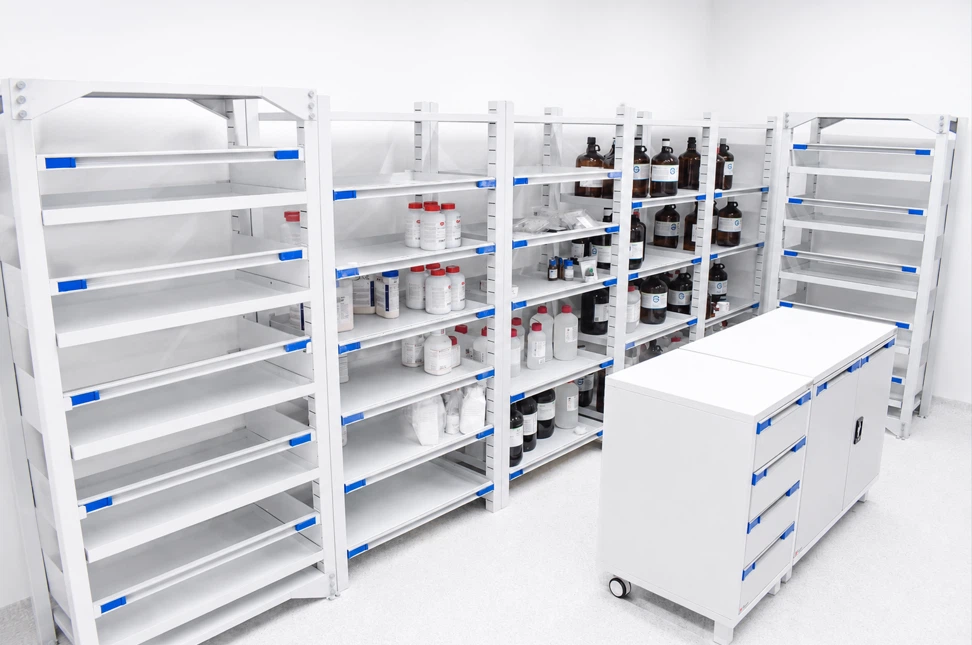
Laboratory storage is often treated as a simple organizational task, but poor storage planning can quickly become a serious operational problem. Overcrowded workspaces, improperly stored chemicals, inaccessible samples, and inefficient shelving systems reduce productivity, increase safety risks, and make regulatory compliance more difficult. As laboratories grow, these issues become even more costly.
This is why laboratory storage should be planned as part of the laboratory’s overall infrastructure rather than as an afterthought. Selecting the right storage solutions for chemicals, samples, and general laboratory supplies improves workflow, protects valuable materials, and maximizes the available space without compromising safety.
Laboratory storage involves much more than finding available space for equipment and materials. Every item stored inside a laboratory has specific environmental, safety, accessibility, and regulatory requirements. Chemicals require secure containment, research samples must remain organized and protected, and laboratory supplies need to be easily accessible without obstructing workflows. An effective laboratory storage system combines different storage solutions that work together to improve organization while maintaining laboratory safety and operational efficiency.
• Safety Storage Cabinets:
Hazardous chemicals present some of the greatest storage challenges in any laboratory. safety storage cabinets are specifically designed to safely contain flammable, corrosive, toxic, and hazardous chemicals while reducing fire risks and accidental exposure. These cabinets are manufactured using fire-resistant construction and incorporate features such as self-closing doors, spill containment sumps, secure locking mechanisms, and ventilation options where required.
Using dedicated safety storage cabinets helps laboratories comply with chemical storage regulations while protecting personnel, equipment, and surrounding laboratory infrastructure. Rather than storing hazardous chemicals on open shelving or beneath workstations, laboratories should isolate incompatible substances inside properly designed safety cabinets.
• Sample Storage Cabinets:
Research samples represent valuable scientific data that may be impossible or extremely expensive to replace. sample storage cabinets provide organized storage that protects specimens from physical damage while improving traceability and inventory management. Adjustable compartments, secure access, labeling systems, and configurable storage layouts allow laboratories to efficiently organize samples according to project, department, or testing protocol.
Well-designed sample storage cabinets reduce sample handling errors, improve retrieval times, and help preserve sample integrity throughout their storage lifecycle. As laboratories accumulate larger collections of biological, chemical, or industrial samples, dedicated sample storage becomes essential for maintaining organization and operational efficiency.
• Shelving Storage:
Not every laboratory item requires enclosed cabinetry. shelving storage provides flexible, high-capacity organization for laboratory supplies, consumables, equipment, glassware, containers, and frequently used materials. Modern laboratory shelving systems are available in steel, stain, and chemical-resistant materials, allowing them to support different environmental conditions and load requirements. Adjustable shelving configurations maximize vertical space while maintaining easy access to stored materials. By utilizing wall space and optimizing storage density, shelving storage helps laboratories increase capacity without expanding their physical footprint.
Optimizing Laboratory Storage begins by understanding that different materials require different storage solutions.
• Separate Materials by Risk Level:
Hazardous chemicals, laboratory samples, and general supplies should never be stored together, dedicated storage systems reduce contamination risks while improving safety and inventory organization.
• Maximize Vertical Space:
Many laboratories underutilize available wall height, installing properly designed shelving storage systems increases storage capacity without reducing valuable workspace. Vertical organization also improves accessibility and minimizes clutter throughout the laboratory.
• Select Purpose-Built Storage Systems:
General-purpose cabinets rarely meet laboratory requirements, using safety storage cabinets for hazardous materials and sample storage cabinets for research specimens ensures that each category of materials receives the protection it requires. Purpose-built storage systems also simplify regulatory compliance and improve operational efficiency.
• Plan for Future Growth:
Storage requirements continue to increase as laboratories expand their operations, selecting modular storage solutions allows laboratories to add capacity without requiring complete facility redesigns. Scalable laboratory storage systems provide long-term flexibility while reducing future expansion costs.
Before selecting laboratory storage solutions, verify:
• Chemical compatibility requirements.
• Storage capacity.
• Fire safety requirements.
• Load capacity.
• Material durability.
• Adjustability and modularity.
• Inventory accessibility.
• Security features.
• Regulatory compliance.
• Future expansion capabilities.
Evaluating these factors helps laboratories create storage systems that remain safe, efficient, and adaptable throughout the facility’s lifecycle.
| Approach | Safety Storage Cabinets | Sample Storage Cabinets | Shelving Storage |
|---|---|---|---|
|
Primary purpose |
Hazardous chemical storage |
Sample organization |
General laboratory storage |
|
Safety level |
Very high |
High |
Moderate |
|
Inventory organization |
Moderate |
Excellent |
Good |
|
Accessibility |
Controlled access |
Organized access |
Immediate access |
|
Space optimization |
Good |
Excellent |
Excellent |
Each solution addresses a different aspect of laboratory storage. safety storage cabinets protect hazardous chemicals, sample storage cabinets preserve valuable research materials, and shelving storage maximizes capacity for laboratory supplies and equipment. Combining all three creates a comprehensive storage strategy that improves safety, organization, and operational efficiency.
Many laboratories reduce storage efficiency because of avoidable planning errors.
• Using One Storage Solution for Everything:
Different laboratory materials require different storage conditions, combining chemicals, samples, and supplies in general-purpose cabinets increases risks and reduces organization.
• Ignoring Chemical Compatibility:
Hazardous substances should always be segregated according to their chemical compatibility, proper safety storage cabinets help prevent dangerous reactions caused by improper storage.
• Underutilizing Vertical Space:
Many laboratories rely only on floor cabinets while leaving wall space unused, proper shelving storage systems significantly increase storage capacity without occupying additional floor area.
• Poor Sample Organization:
Without dedicated sample storage cabinets, laboratories often experience misplaced samples, inventory confusion, and longer retrieval times, organized storage improves both efficiency and traceability.
• Planning Only for Current Needs:
Storage requirements increase over time, selecting scalable storage systems today prevents expensive renovations as laboratory operations continue to grow.
Effective laboratory storage is far more than an organizational improvement—it directly influences laboratory safety, productivity, inventory control, and long-term operational efficiency. By combining safety storage cabinets, sample storage cabinets, and shelving storage, laboratories can optimize available space while protecting hazardous chemicals, preserving valuable research materials, and improving day-to-day workflow. Rather than viewing storage as a collection of individual cabinets, laboratories should develop a comprehensive laboratory storage strategy that supports future growth while creating a safer, more organized, and more efficient working environment.
No. Acids and bases are incompatible chemicals that must be stored in separate safety cabinets. If containers leak or break inside the cabinet, mixing acids and bases can produce violent exothermic reactions, toxic fumes, or corrosive splashes. Acid-rated safety cabinets typically feature polyethylene or polypropylene-lined interiors that resist acid corrosion, while base cabinets use different liner materials.
Norlab manufactures dedicated safety laboratory storage cabinets for both acid and base storage, each with appropriate interior coatings and ventilation configurations to ensure safe segregated containment.
No, and this is one of the most consequential mix-ups in laboratory procurement. sample storage cabinets are engineered for the secure organization and integrity protection of biological specimens, research materials, HPLC columns, and glassware. They are not rated, listed, or designed to contain flammable liquids, concentrated acids, or other hazardous chemicals.
Safety laboratory storage cabinets — which are a separate product category — are FM-listed or UL-listed, built with double-wall steel construction, intumescent door seals, and self-closing mechanisms specifically to contain a fire event and meet NFPA 30 and OSHA 29 CFR 1910.106 requirements. Storing flammables in a sample storage cabinet creates a serious fire and compliance risk. If your facility needs both types of storage, Norlab’s safety storage cabinets line covers hazardous chemical storage, and sample storage cabinets handle everything else.
Modern shelving storage systems use vertical space efficiently and can be configured to suit changing laboratory requirements. Mobile shelving units, rivet racks, and lockers help increase laboratory storage capacity while maintaining safe access to equipment, supplies, and personal items without expanding the facility footprint.
With proper use and maintenance, safety laboratory storage cabinets from Norlab have an expected structural lifespan of 15–25 years. The most common causes of premature deterioration are: storing incompatible chemicals that produce corrosive vapors attacking the interior coating, overloading shelves beyond their rated capacity (121.2 lb per shelf), failing to clean spills promptly from the pull-out trays, and neglecting ventilation which allows corrosive vapor concentration to degrade interior surfaces.
The heavy-duty steel construction and powder-coated finishes on Norlab safety storage cabinets are engineered to resist these degradation factors under normal laboratory operating conditions.
The lockable door mechanisms on Norlab’s sample storage cabinets provide the physical access control layer that chain-of-custody protocols require. In regulated environments — pharmaceutical QC labs, forensic labs, clinical diagnostic facilities, and ISO 17025-accredited testing labs — the cabinet must restrict unauthorized access to samples and maintain a documented access record. The lock configuration options (keyed, master-keyed, or restricted-key systems) are specified based on your access control requirements during the design phase.
For facilities that require electronic access logging, the cabinet’s lock interface can be specified to accommodate electronic lock hardware. Label holder features on each shelf and compartment support the physical traceability layer — each storage position can be labeled with sample identifiers, lot numbers, or storage condition requirements, reducing handling errors during retrieval.

Looking for a personalized quote on laboratory design or customized laboratory furniture?
We support your project with fully managed design & manufacturing solutions, ensuring every detail aligns with your workflow, safety needs, and performance requirements.
 Expert guidance included — free 3D design
Our lab safety specialists review your project personally.
 Fully custom — material, dimensions, configuration & finish
Furniture designed around your lab’s workflow, space constraints, and compliance requirements.
 American owned & operated — nationwide delivery
Manufactured and supported from Florida.