
In This Article, You’ll Learn: how mobile shelving maximizes laboratory storage capacity without sacrificing accessibility, which design features have the greatest impact on space efficiency and organization, what to evaluate before selecting a mobile shelving system, and how to choose the right solution for your laboratory.
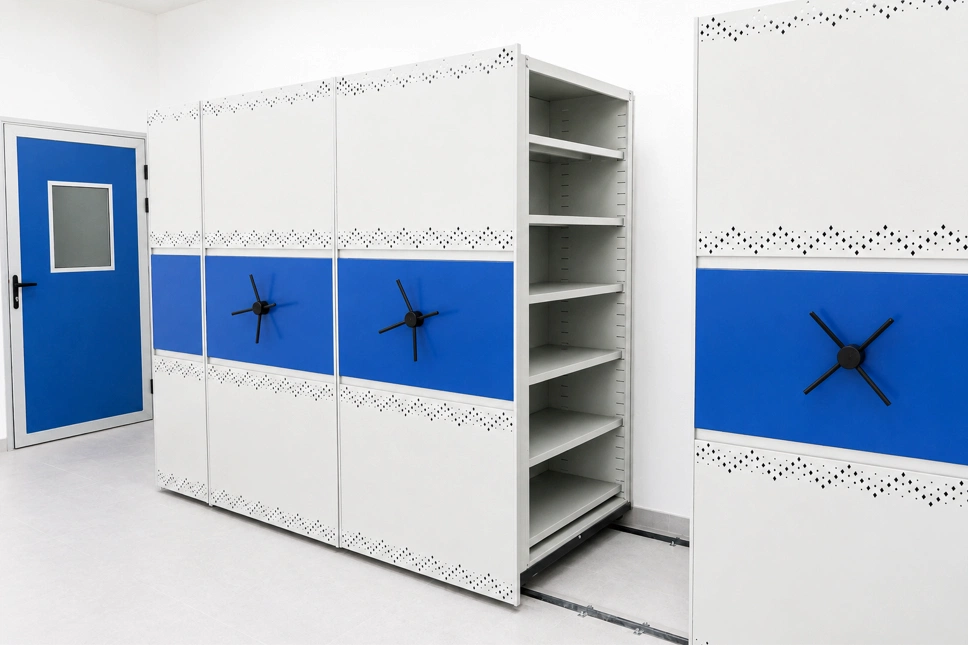
Mobile shelving is a high-density storage system that maximizes laboratory floor space by allowing shelving units to move along floor-mounted rails. Instead of maintaining permanent access aisles between every shelving unit, only the aisle being used remains open. Compared with conventional shelving, mobile shelving can increase storage capacity by 50% or more while improving organization, protecting stored materials, simplifying inventory management, and reducing the need for costly facility expansion. When properly specified, shelving provides one of the most efficient storage solutions for modern laboratories.
Unlike traditional fixed shelving systems, mobile shelving mounts storage units onto mobile carriages that move smoothly along precision rails. Rather than dedicating permanent aisle space between every shelving section, users simply open the aisle where access is required. Once materials are retrieved or stored, the shelving units can be repositioned to create access elsewhere. This concept dramatically increases storage density while preserving accessibility. Modern mobile systems may include:
• Manual mechanical drive systems
• Assisted mechanical movement
• Powered or automated operation
• Safety locking mechanisms
• Anti-tip protection
• Load distribution systems
• Adjustable shelving configurations
These features allow laboratories to maximize available storage while maintaining safety and ease of use.
• Maximizes Floor Space:
One of the greatest advantages of mobile shelving is its ability to eliminate unused aisle space. Traditional shelving requires multiple permanent aisles that remain empty most of the time, mobile systems reduce these unused areas, allowing laboratories to dedicate more space to actual storage rather than circulation. For facilities with limited square footage, mobile shelving can often postpone or eliminate expensive building expansions.
• Improves Organization:
Higher storage density does not have to mean reduced organization, properly designed mobile shelving systems support logical storage layouts by grouping materials according to laboratory function, department, project, or inventory category. This organized approach reduces search time, improves inventory control, and minimizes misplaced materials.
• Protects Samples and Laboratory Materials:
Many laboratories store valuable research samples, archived documentation, analytical standards, or sensitive supplies, mobile shelving protects these materials by keeping them organized, reducing unnecessary handling, and minimizing exposure to dust or accidental damage, specialized shelving configurations can also accommodate boxes, containers, laboratory supplies, and archival records while maintaining easy access.
• Supports Flexible Storage Configurations:
Laboratory storage requirements change continuously, adjustable mobile shelving systems can be reconfigured to accommodate:
• Laboratory supplies
• Glassware
• Research documentation
• Sample containers
• Archive boxes
• Equipment accessories
• Instruments and components
This flexibility allows storage systems to evolve alongside laboratory operations without replacing the entire installation.
• Improves Long-Term Space Efficiency:
Every square meter inside a laboratory represents a significant investment, by increasing storage density within the existing footprint, Mobile Shelving helps laboratories make better use of available space while maintaining safe circulation and efficient workflows. The result is lower infrastructure costs and improved long-term operational efficiency.
Selecting the appropriate mobile shelving solution requires evaluating several operational factors.
• Evaluate Storage Capacity:
Begin by calculating both current and projected storage needs, selecting a system that only satisfies today’s requirements often leads to overcrowding within a few years.Planning for future growth provides better long-term value.
• Consider Load Requirements:
Different laboratories store materials with vastly different weights, shelving systems should be selected according to:
• Maximum shelf load
• Total carriage capacity
• Floor load limitations
• Structural stability
Proper load calculations ensure smooth operation and long-term reliability.
• Verify Available Space:
Room dimensions influence rail configuration, shelving depth, aisle width, and carriage length, careful planning ensures mobile integrates efficiently without interfering with doors, utilities, emergency exits, or laboratory equipment.
• Prioritize Safety Features:
High-density storage systems should include integrated safety mechanisms, important features include:
• Anti-tip protection
• Emergency release systems
• Mechanical locking devices
• Obstruction detection (powered systems)
• Stable rail alignment
These features protect both personnel and stored materials during daily operation.
• Plan for Future Expansion:
Storage demands rarely remain constant, choosing modular mobile shelving systems allows additional sections or reconfigurations as laboratory requirements evolve, extending the lifespan of the investment.
Before selecting a mobile shelving system, verify:
• Total storage capacity required.
• Available floor space and room dimensions.
• Floor load capacity.
• Rail installation requirements.
• Load capacity per shelving unit.
• Safety locking and anti-tip features.
• Expandability for future storage needs.
• Ease of maintenance and operation.
• Compatibility with stored laboratory materials.
Evaluating these factors helps ensure the storage system supports both current operations and future laboratory growth.
| Feature | Mobile Shelving | Traditional Fixed Shelving |
|---|---|---|
|
Storage capacity |
Very high |
Moderate |
|
Floor space efficiency |
Excellent |
Moderate |
|
Future expandability |
High |
Limited |
|
Organization |
Excellent |
Good |
|
Accessibility |
Controlled access |
Permanent access |
|
Installation cost |
Higher initial investment |
Lower initial cost |
While traditional shelving remains suitable for many applications, mobile shelving offers significantly greater storage density and long-term space optimization, for laboratories where available floor space is limited, shelving often provides the highest return on investment.
Many laboratories fail to maximize the benefits of shelving because of planning errors made during specification.
• Selecting Capacity Based Only on Current Needs:
Ignoring future growth often results in overcrowded storage and additional investments sooner than expected.
• Ignoring Floor Load Capacity:
High-density storage concentrates more weight in smaller areas, floor structural capacity should always be evaluated before installation.
• Poor Storage Organization:
Even advanced mobile shelving loses efficiency without a logical inventory system, materials should be organized according to laboratory workflow and retrieval frequency.
• Choosing the Wrong Shelving Configuration:
Shelf dimensions, spacing, and load capacity should match the materials being stored rather than relying on generic configurations.
• Overlooking Safety Features:
Mechanical stability, locking systems, and proper rail installation are essential for safe daily operation and long-term reliability.
As laboratories continue to manage increasing volumes of samples, documentation, supplies, and equipment, maximizing available storage space becomes a strategic priority, mobile shelving provides one of the most effective solutions by significantly increasing storage capacity without expanding the laboratory footprint. Through intelligent space utilization, improved organization, flexible configurations, and enhanced protection for stored materials, these systems help laboratories operate more efficiently while controlling infrastructure costs.
Rather than viewing mobile shelving as simply another storage option, laboratories should consider it a long-term investment that improves operational efficiency, supports future growth, and makes better use of every square meter available.
mobile shelving eliminates unnecessary permanent aisles, allowing laboratories to significantly increase storage capacity while using the same floor space more efficiently.
Depending on the layout, mobile shelving systems can often increase storage capacity by 50% or more compared to conventional fixed shelving.
Yes. Properly designed mobile shelving includes safety features such as anti-tip mechanisms, locking systems, stable rail assemblies, and controlled movement that ensure safe daily operation.
Mobile shelving can accommodate laboratory supplies, archived records, samples, glassware, equipment accessories, research documentation, and many other materials when properly configured.
Laboratories should assess available floor space, structural floor capacity, storage volume, shelving load requirements, safety features, future expansion plans, and workflow needs to ensure the system delivers maximum long-term value.

Looking for a personalized quote on laboratory design or customized laboratory furniture?
We support your project with fully managed design & manufacturing solutions, ensuring every detail aligns with your workflow, safety needs, and performance requirements.
 Expert guidance included — free 3D design
Our lab safety specialists review your project personally.
 Fully custom — material, dimensions, configuration & finish
Furniture designed around your lab’s workflow, space constraints, and compliance requirements.
 American owned & operated — nationwide delivery
Manufactured and supported from Florida.